
Control of the U.S. House 2026
- Polymarket
- 90.5%
- Kalshi
- 90.1%
- Spread
- 1.0 pts
- 24h
- –
- 7 days
- +0.4
- Updated
- Oct 16, 2026, 1:45 PM ET
Democratic Party, last 60 days
How to read this chart
The green line is the TruthIndex™, the chance of this outcome. It combines the prices on both venues and gives more weight to the venue with more money in its order book. The two thinner lines are Polymarket's and Kalshi's own prices, and the grey band between them shows how far apart the two venues are.
The pale bands behind the lines are the rating zones (Toss-up, Lean, Likely and Safe), so you can see when the race moved from one rating to another. Move along the chart, or use the arrow keys, to read the values for each day.
More in MethodologyAll outcomes
| Outcome | TruthIndex™ | Polymarket | Kalshi | Spread | 24h | |
|---|---|---|---|---|---|---|
| DDemocratic Party | 90.4% | 90.5% | 90.1% | 0.4 pts | – | |
| RRepublican Party | 10.0% | 9.5% | 10.5% | 1.0 pts | – |
Share this race
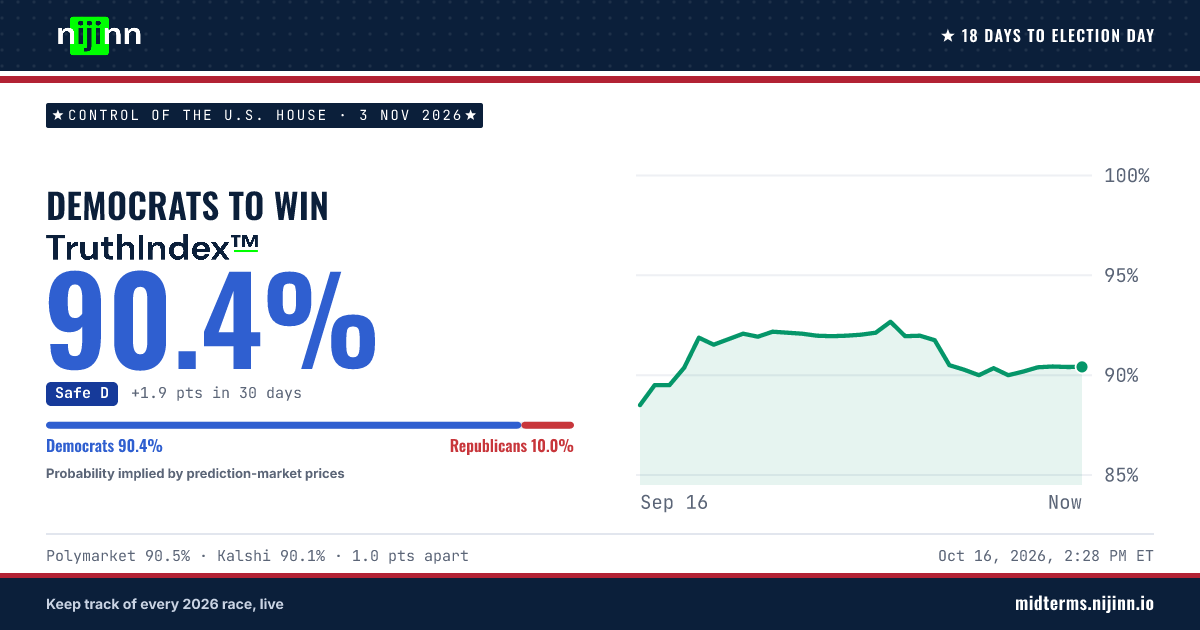
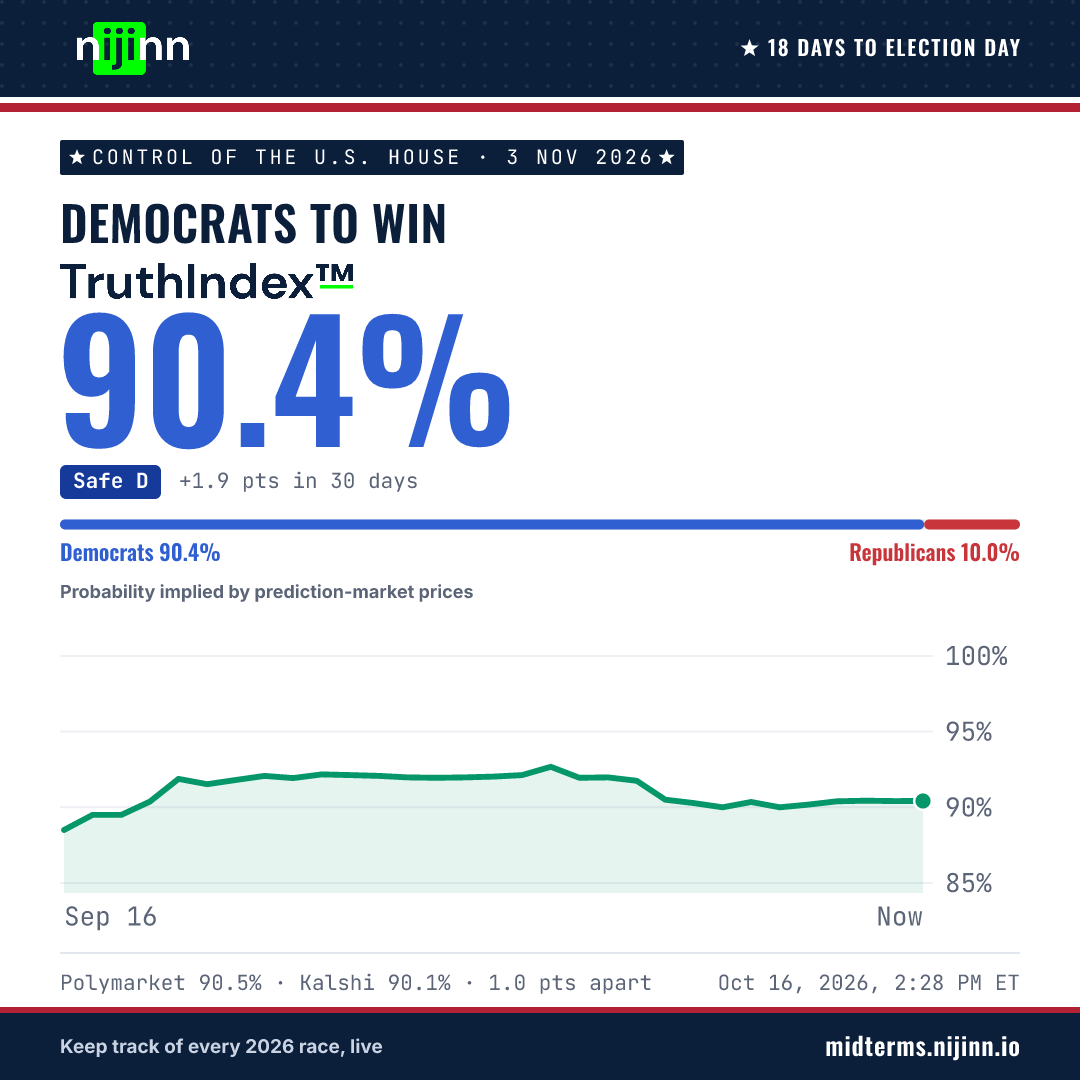
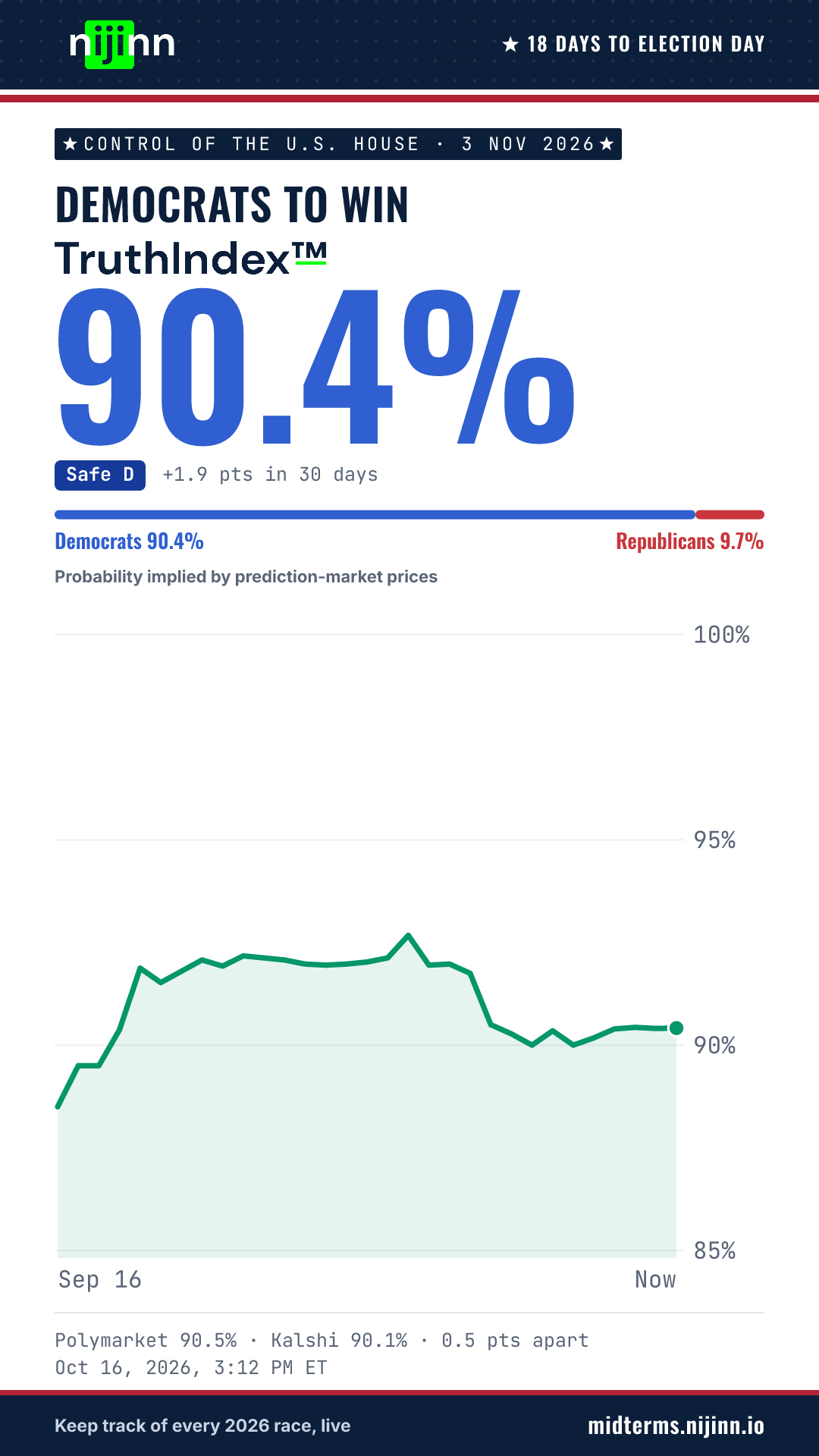
Image cards with the current TruthIndex™, for posts and stories.
Post on X
X opens with your text; you can edit it there before posting.
Embed the live card
Democrats have a 90.4% chance to control the House on the TruthIndex™
Polymarket 90.5% · Kalshi 90.1% · 1.0 pts apart
X opens with your text; you can edit it there before posting.
https://midterms.nijinn.io/share/house-balance/How to read this chart
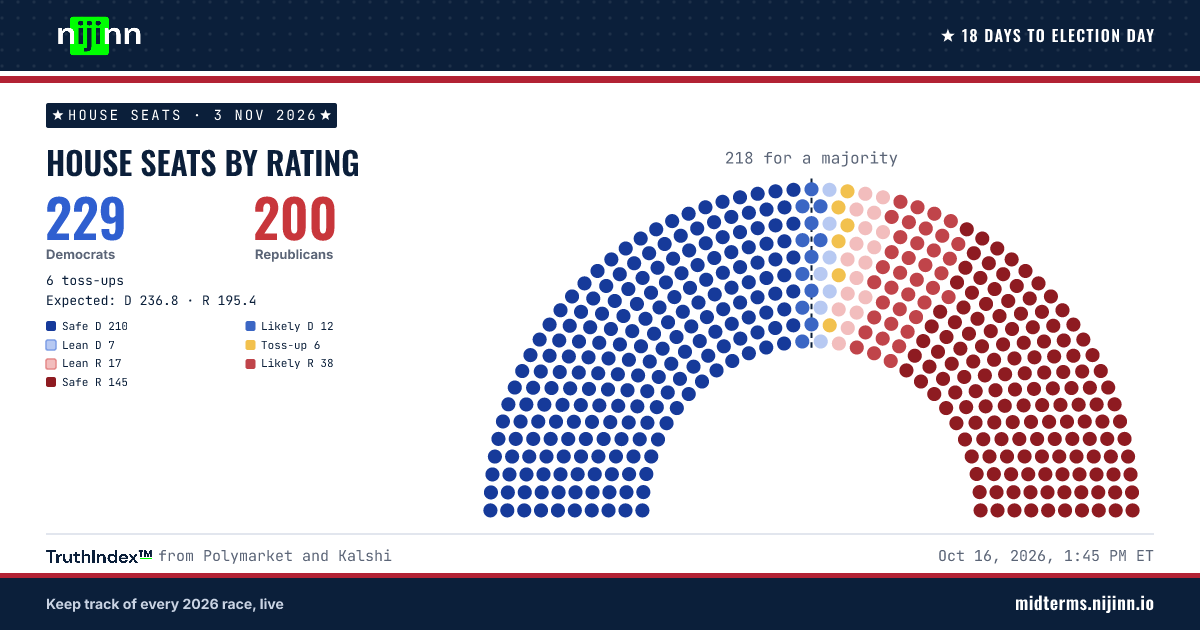
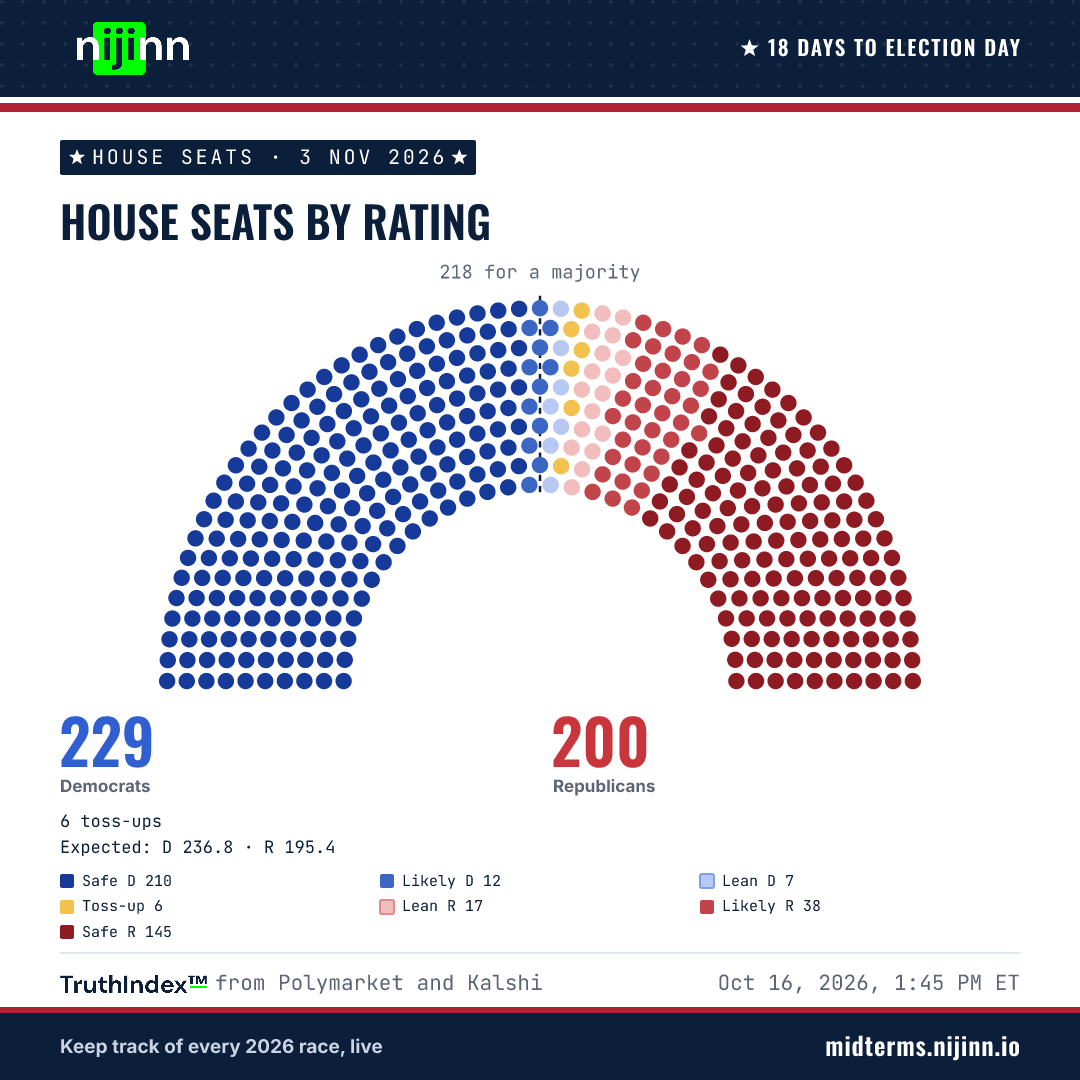
Each dot is one House seat. Dots on the left are races Democrats are favoured to win, and dots on the right are races Republicans are favoured to win. A strong colour means the market is confident about the winner; a pale colour means a closer race. Yellow dots in the middle are toss-ups, where no side has a 60% chance or more.
The dashed line marks 218 seats, the number a party needs for a majority. Select a dot to open that race.
More in Methodology- Safe DemocratSafe D 210
- Likely DemocratLikely D 12
- Lean DemocratLean D 7
- Toss-up 6
- Lean RepublicanLean R 17
- Likely RepublicanLikely R 38
- Safe RepublicanSafe R 145
House seats after the midterms
How many House seats each party holds after the midterms. Each venue's market is shown on its own.
Kalshi4.2M contracts
How many House seats will Republicans hold after the Midterms?
| Below 193 | 30.5% | |
| 193-197 | 15.5% | |
| 198-202 | 14.5% | |
| 203-207 | 14.5% | |
| 208-212 | 8.8% | |
| 213-217 | 7.6% | |
| 218-222 | 5.0% | |
| 223-227 | 2.6% | |
| 228-232 | 1.7% | |
| 233-237 | 1.5% | |
| Above 237 | 1.5% |
Kalshi3.1M contracts
How many House seats will Democrats hold after the Midterms?
| Below 210 | 4.2% | |
| 210-213 | 2.1% | |
| 214-217 | 2.9% | |
| 218-221 | 5.0% | |
| 222-225 | 7.1% | |
| 226-229 | 11.5% | |
| 230-233 | 15.5% | |
| 234-237 | 17.5% | |
| 238-241 | 13.5% | |
| 242-245 | 9.0% | |
| 246-249 | 6.7% | |
| Above 249 | 11.5% |
Polymarket$332.2K traded
Republican House seats after the 2026 midterm elections?
| Below 190 | 24.0% | |
| 190-194 | 13.5% | |
| 195-199 | 10.0% | |
| 200-204 | 10.1% | |
| 205-209 | 24.0% | |
| 210-214 | 5.2% | |
| 215-219 | 5.5% | |
| 220-224 | 2.3% | |
| 225-229 | 0.9% | |
| 230+ | 1.4% |
Balance of power in Congress
Which party controls each chamber after the midterms. Each venue's market is shown on its own.
Kalshi40.7M contracts
2026 Midterms: Congress Balance of Power?
| Democrats sweep | 61.5% | |
| D-House, R-Senate | 30.5% | |
| Republicans sweep | 10.5% | |
| R-House, D-Senate | 0.8% |
Polymarket$24.3M traded
Balance of Power: 2026 Midterms
| Democrats Sweep | 62.5% | |
| R Senate, D House | 27.5% | |
| Republicans Sweep | 9.5% | |
| D Senate, R House | 0.9% | |
| Other | 0.1% |
Each venue's market
Polymarket$17.9M traded
Prices which party wins.
Democratic Party: Counted · bid 90.0% / ask 91.0% · $2.4M within 5 pts
This market will resolve according to the party that wins control of the United States House of Representatives in the 2026 United States midterm election. A party wins control of the United States House of Representatives if it wins a majority of the chamber’s voting seats. If no party wins a majority of voting seats, the chamber will be deemed controlled by the party with which the first elected Speaker of the House of the Congress that convenes after the 2026 midterm election is affiliated. The following rules govern the counting of seats for determining which party wins control of the chamber. All House elections in the 2026 United States midterm election that elect voting members and determine representation in the upcoming 120th Congress are included. Where a seat is decided by a runoff, the runoff result will determine attribution of that seat. Seats are attributed to the party under which the member was elected. If a member-elect changes party affiliation, or vacates their seat, between election day and the formal organization of Congress, the seat is attributed to the party under which the member was elected. House members elected as independents who formally caucus with, or, for newly elected members, who announce their intent to caucus with, a party are included in that party’s count. If the caucus decisions of members of the House elected as independents cannot be determined on the date of the election, this market may remain open until the earlier of (i) an announcement from the relevant members of their intents to caucus, or (ii) January 4th, 11:59 PM ET of the following calendar year. If no such announcement is made by January 4th, 11:59 PM ET of the following calendar year, the member will not count towards the seat count of any party. The resolution sources for this market will be official information from relevant state electoral authorities, the United States Congress, and a consensus of credible reporting.
Full rules on PolymarketKalshi58.8M contracts traded
Prices which party wins.
Democratic Party: Counted · bid 90.1% / ask 90.2% · $761.5K within 5 pts
Contract shown: Democratic Party
If the Democratic Party has won control of the House in 2026, then the market resolves to Yes.
This market may be determined early based on a consensus of media calls projecting control of the U.S. House. See full rules for details. Otherwise, victory will be determined by the party identification of the Speaker of the House on February 1, 2027.